



Introduction
In today’s fast-paced digital economy, businesses rely on multiple systems to manage operations, customers, finances, and supply chains. However, when these systems operate in isolation, it often leads to inefficiencies, data silos, and poor decision-making. This is where Integrated Business Solutions come into play.
Understanding the Integrated Business Solutions Meaning is essential for modern organizations aiming to streamline operations and improve productivity. These solutions connect various business processes and technologies into a unified system, enabling seamless data flow and better coordination across departments.
By adopting integrated solutions, companies can make smarter decisions, enhance collaboration, and respond quickly to market changes—ultimately gaining a competitive advantage in their industry.
What Are Integrated Business Solutions?
The term Integrated Business Solutions Meaning refers to a unified approach where different business systems, processes, and technologies are combined into a single, cohesive platform.
Instead of using separate tools for accounting, customer management, inventory, and human resources, integrated solutions bring everything together. This ensures that data flows smoothly across departments without duplication or manual intervention.
In simple terms, business integration allows organizations to operate more efficiently by connecting all essential functions into one system, often referred to as enterprise solutions.
Key Components of Integrated Business Solutions
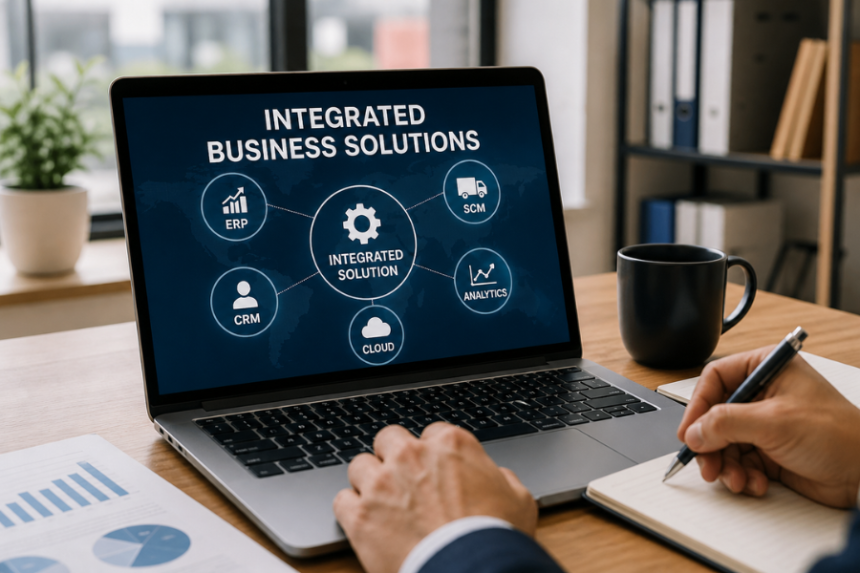
Integrated systems are built using several core components that work together to create a seamless business environment:
1. ERP (Enterprise Resource Planning)
ERP systems manage core business processes such as finance, HR, procurement, and operations. They act as the backbone of integrated solutions, ensuring centralized data management.
2. CRM (Customer Relationship Management)
CRM systems help businesses manage customer interactions, sales pipelines, and marketing campaigns, improving customer satisfaction and retention.
3. SCM (Supply Chain Management)
SCM solutions optimize the flow of goods, services, and information across the supply chain—from suppliers to customers.
4. Data Integration & Analytics
Data integration tools collect and unify data from various sources, while analytics platforms provide insights that support data-driven decision-making.
5. Cloud-Based Platforms
Modern integrated business solutions often rely on cloud technology, allowing businesses to access systems anytime, anywhere, with enhanced scalability and security.
Benefits of Integrated Business Solutions
Adopting integrated solutions offers numerous advantages for organizations of all sizes:
Improved Efficiency and Productivity
Automation and streamlined workflows reduce manual tasks, saving time and improving operational efficiency.
Better Data Accuracy and Real-Time Insights
With a centralized system, data is consistent and updated in real time, reducing errors and enabling informed decisions.
Enhanced Collaboration Across Departments
Integrated systems break down silos, allowing teams to share information easily and work more collaboratively.
Cost Reduction and Scalability
By eliminating redundant systems and improving resource utilization, businesses can reduce costs and scale operations effectively.
Examples of Integrated Business Solutions
Several leading platforms provide comprehensive integrated business solutions used by organizations worldwide:
- SAP: Offers powerful ERP systems that integrate finance, logistics, and human resources.
- Oracle: Provides cloud-based enterprise solutions for data management, analytics, and business operations.
- Microsoft Dynamics: Combines CRM and ERP capabilities for seamless business integration.
- Zoho: Delivers affordable, cloud-based integrated tools for small and medium businesses.
These platforms help businesses centralize operations, improve data visibility, and enhance decision-making.
How to Implement Integrated Business Solutions
Implementing integrated business solutions requires a strategic approach. Here’s a step-by-step guide:
1. Assess Business Needs
Identify current challenges, inefficiencies, and goals to determine what kind of integration is required.
2. Choose the Right Software/Tools
Select platforms that align with your business size, industry, and long-term objectives.
3. Integration Planning
Develop a clear roadmap for integrating systems, including timelines, resources, and potential risks.
4. Employee Training
Ensure employees understand how to use the new system effectively to maximize adoption and productivity.
5. Continuous Monitoring
Regularly evaluate system performance, update processes, and optimize workflows for ongoing improvement.
Challenges and Considerations
While integrated solutions offer many benefits, businesses should be aware of potential challenges:
- High Initial Cost: Implementation and customization can require significant investment.
- Data Migration Issues: Transferring data from legacy systems can be complex and time-consuming.
- Resistance to Change: Employees may be hesitant to adopt new systems and processes.
- Security Concerns: Integrating systems increases the need for robust cybersecurity measures.
Proper planning and change management strategies can help overcome these challenges.
Future Trends in Integrated Business Solutions
The future of integrated business solutions is shaped by emerging technologies and evolving business needs:
- Artificial Intelligence (AI): Enhances automation, predictive analytics, and decision-making.
- Advanced Automation: Reduces manual work and improves operational speed.
- Cloud Computing: Continues to drive scalability, flexibility, and remote accessibility.
- Digital Transformation: Businesses are increasingly adopting integrated systems to stay competitive in a digital-first world.
These trends will make integrated solutions even more powerful and essential for modern enterprises.
Conclusion
Understanding the Integrated Business Solutions Meaning is crucial for businesses aiming to improve efficiency, collaboration, and decision-making. By integrating various systems into a unified platform, organizations can eliminate data silos, reduce costs, and enhance overall performance.
As technology continues to evolve, integrated business solutions will play an even greater role in driving innovation and helping companies remain competitive in a rapidly changing marketplace.