



Introduction
Modern vehicles are no longer just about speed and power—they are increasingly defined by intelligent systems that enhance safety, comfort, and control. One such innovation is Active Cornering Enhancement, a cutting-edge vehicle stability technology designed to reduce body roll and improve handling during turns. As road conditions and driving demands become more complex, technologies like ACE are transforming how vehicles respond to dynamic situations.
Whether you’re navigating sharp corners on a mountain road or making sudden maneuvers in city traffic, stability is crucial. Traditional suspension systems often struggle to maintain balance under such conditions. This is where Active Cornering Enhancement stands out, offering superior control through an advanced active suspension system that adapts in real time.
In this article, we’ll explore how Active Cornering Enhancement works, its features, benefits, comparisons with traditional systems, and what the future holds for this innovative technology.
What is Active Cornering Enhancement?
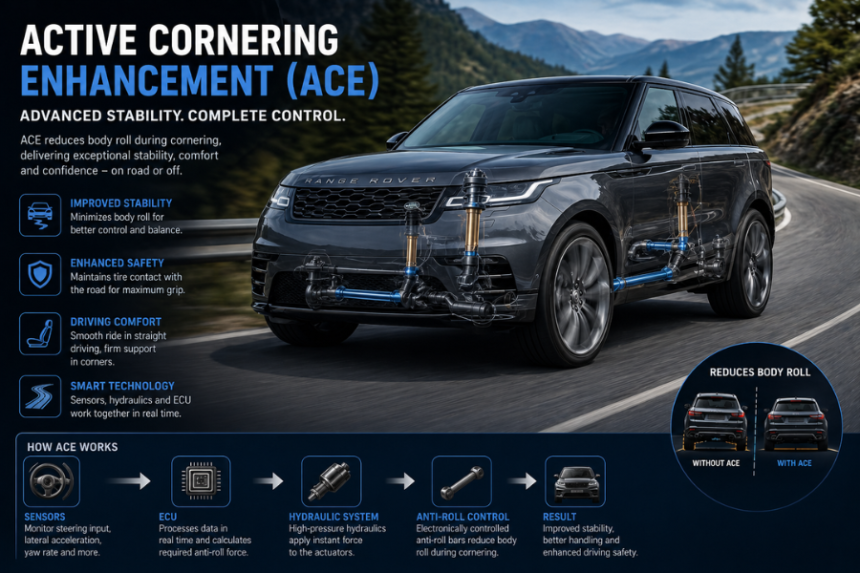
Active Cornering Enhancement (ACE) is an advanced anti-roll system used in vehicles to minimize body roll during cornering. Body roll occurs when a vehicle leans to one side while turning, which can reduce traction and compromise stability.
ACE uses a combination of sensors, hydraulic actuators, and an Electronic Control Unit (ECU) to actively counteract this motion. Unlike passive systems that rely on fixed mechanical components, ACE dynamically adjusts the suspension to maintain a level ride.
In simple terms, Active Cornering Enhancement helps keep your vehicle stable and balanced—even when taking sharp turns at higher speeds.
How Active Cornering Enhancement Works
The effectiveness of Active Cornering Enhancement lies in its intelligent integration of multiple components. Let’s break down how this active suspension system operates:
Sensors
Sensors play a critical role in detecting vehicle behavior. These include:
- Steering angle sensors
- Lateral acceleration sensors
- Wheel speed sensors
These sensors continuously monitor how the vehicle is moving and send real-time data to the ECU.
Hydraulic System / Actuators
The hydraulic system is responsible for applying force to the suspension. When the system detects body roll:
- Hydraulic actuators apply pressure to the anti-roll bars
- This pressure counteracts the leaning motion
- The vehicle remains more level during turns
This immediate response is what makes ACE highly effective compared to traditional systems.
Electronic Control Unit (ECU)
The ECU acts as the brain of the system. It:
- Processes data from sensors
- Determines how much correction is needed
- Sends commands to the hydraulic actuators
The ECU ensures that adjustments happen instantly and precisely.
Anti-Roll Control
The anti-roll bars are actively controlled instead of being fixed. ACE:
- Stiffens the suspension during cornering
- Relaxes it during straight driving for comfort
This dual behavior provides both stability and smoothness—something passive systems cannot achieve.
Key Features of ACE Technology
Active Cornering Enhancement comes with several innovative features that make it a standout vehicle stability technology:
- Real-Time Adjustment
Continuously adapts suspension based on driving conditions - Hydraulic Actuation
Provides immediate response to body roll - Dynamic Anti-Roll Bars
Adjust stiffness automatically - Integrated Sensor Network
Ensures precise monitoring of vehicle movement - Enhanced Driving Modes
Works seamlessly with different terrain or driving modes
Benefits of Active Cornering Enhancement
Improved Stability
ACE significantly reduces body roll, keeping the vehicle balanced during sharp turns and sudden maneuvers.
Better Cornering Control
Drivers experience improved grip and handling, especially on winding roads or at higher speeds.
Enhanced Safety
By maintaining better tire contact with the road, ACE reduces the risk of skidding or rollover accidents.
Driving Comfort
Unlike stiff traditional systems, ACE offers a smooth ride during normal driving while becoming firm only when needed.
ACE vs Traditional Suspension Systems
Here’s a comparison between Active Cornering Enhancement and traditional suspension systems:
| Feature | Active Cornering Enhancement | Traditional Suspension |
| Adaptability | Real-time adjustments | Fixed behavior |
| Body Roll Control | Actively minimized | Passive resistance |
| Comfort | High (adaptive) | Moderate |
| Complexity | Advanced (ECU + hydraulics) | Simple mechanical |
| Cost | Higher | Lower |
| Performance | Superior cornering | Limited control |
In essence, ACE offers a smarter and more responsive solution compared to conventional suspension setups.
Vehicles That Use Active Cornering Enhancement
Active Cornering Enhancement is commonly found in premium and off-road vehicles, particularly from brands like:
- Land Rover
- Range Rover
Models such as the Range Rover Sport and Discovery series are known for incorporating ACE to deliver both off-road capability and on-road comfort.
Advantages and Disadvantages
Advantages
- Excellent stability and reduced body roll
- Improved safety and control
- Enhanced ride comfort
- Adaptive performance for different terrains
Disadvantages
- Higher cost compared to traditional systems
- Increased system complexity
- Maintenance can be more expensive
- Potential for hydraulic system issues over time
While ACE offers numerous benefits, it is typically found in higher-end vehicles due to its cost and complexity.
Future of Active Cornering Enhancement
The future of Active Cornering Enhancement looks promising as automotive technology continues to evolve. Key trends include:
AI Integration
Artificial intelligence is expected to enhance ACE systems by:
- Predicting driving conditions
- Learning driver behavior
- Optimizing suspension responses automatically
Electrification
Future systems may replace hydraulic components with electric actuators, making them:
- More efficient
- Lighter
- Easier to maintain
Autonomous Driving Compatibility
As self-driving vehicles become more common, ACE will play a crucial role in ensuring smooth and stable rides without human intervention.
Smart Connectivity
Integration with vehicle networks will allow ACE to:
- Communicate with other safety systems
- Adjust based on navigation data (e.g., upcoming curves)
Conclusion
Active Cornering Enhancement represents a major leap forward in vehicle stability technology. By combining sensors, hydraulics, and intelligent control systems, it delivers superior handling, safety, and comfort.
Compared to traditional suspension systems, ACE provides dynamic adaptability that significantly improves driving performance—especially in challenging conditions. While it comes with higher costs and complexity, its benefits make it a valuable feature in modern vehicles.
As innovations like AI and electrification continue to evolve, Active Cornering Enhancement is set to become even more advanced, shaping the future of smart and safe mobility.
In a world where driving demands are constantly increasing, technologies like ACE are not just enhancements—they are becoming necessities.